


Syllabus: GS3/Economy
Context
- Many countries in the world Including France, Spain, Albania and even India are witnessing mobilisation by youths.
About
- France has witnessed severe economic problems — high unemployment, low growth, rising cost of living, falling real wages and severe cutbacks in public expenditure.
- At the heart of it all is the neoliberal economic model, which aggressively enforced reduced public expenditure in general, and welfare spending in particular.
Causes of Youth Unemployment
- Slow Economic Growth: Slower economic growth limits the expansion of businesses and reduces the creation of new jobs.
- There is a declining youth population in many developed countries and still youth unemployment remains high.
- This indicates that the problem is not merely an excess supply of labour but also insufficient demand for it.
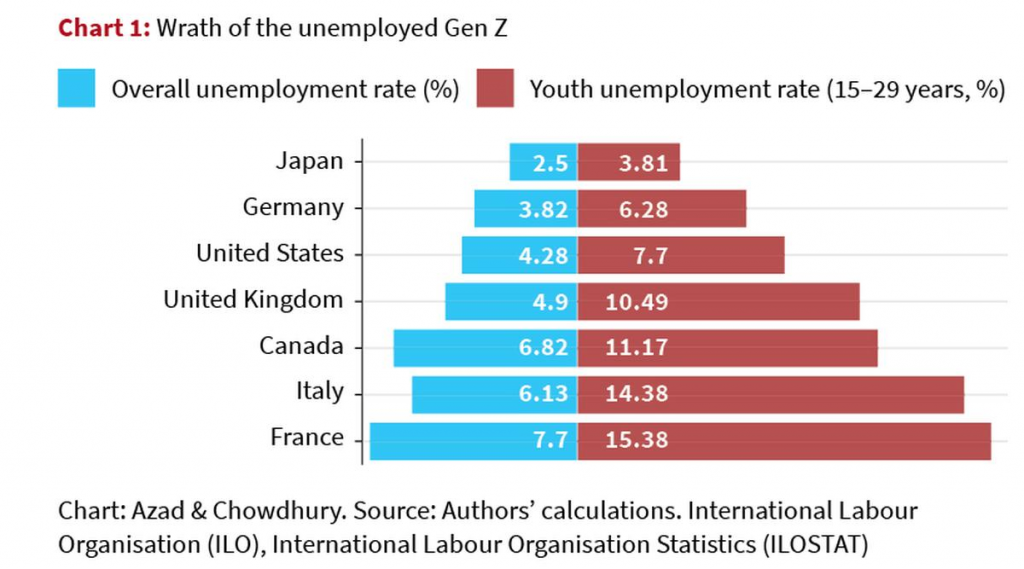
- Declining Investment: According to heterodox economic approaches, employment depends significantly on investment and overall demand for goods and services. When businesses reduce investment, economic activity slows, reducing the demand for workers.
- Neoliberal Economic Policies: Neoliberalism emphasises market-led growth, which means reduced government intervention including privatisation and fiscal restraint.
- The reduced public expenditure coupled with weakening of labour unions and reduced welfare support have contributed to economic insecurity and weakened workers’ bargaining power.
- Rising Inequality and Underconsumption: When wages grow slowly or the share of national income going to workers declines, the household consumption also weakens.
- Lower consumption can discourage businesses from investing in additional production, creating a cycle of slow growth and unemployment.
- Technological Displacement: Automation and artificial intelligence (AI) have replaced certain tasks performed by workers, potentially reducing demand for some jobs.
- Young people entering the labour market face greater competition if the creation of new jobs does not keep pace with technological change.
- Rising Cost of Education: Education has become increasingly expensive in many countries, while obtaining a degree does not guarantee secure or adequately paid employment.
- This creates financial pressure and frustration among young people, particularly those who struggle to find jobs matching their qualifications.
Way Forward
- Promote Employment-Intensive Growth: There is a need to encourage labour-intensive sectors, support small and medium enterprises, and increase investment in infrastructure and public services to expand employment opportunities.
- Improve Education and Skill Development: Affordable education, vocational training and stronger links between educational institutions and employers can help young people access suitable employment.
- Manage Technological Change: Governments and businesses should invest in reskilling, worker protection and the creation of new employment opportunities to address the disruptive effects of automation and AI.
- Strengthen Labour Market Institutions: Effective labour protections, collective bargaining and fair wages can improve workers’ bargaining power while supporting sustainable economic growth.
Conclusion
- Youth unemployment is not merely a problem of individual skills or employability; it is also linked to investment, aggregate demand, wage distribution and the structure of economic growth.
- There is a need for a balanced approach combining productive investment, effective public policies, social protection and opportunities for decent work.
- Reducing youth unemployment is essential not only for economic stability but also for social inclusion and intergenerational equity.
Source: TH
Previous article
Khelo India Sports Goods Manufacturing Scheme
Next article
Immersive Technologies
